Definitely a Hurricane

So last night, in an effort to run away and join the Shakespeare circus for an evening instead of agonizing over the proper usage of periods in Chicago-style citation (seriously, Tufts, you are BLOWING THE MIND of this MLA-girl… guess I should get used to it since this is the rest of my life… sigh), I took my gay best friend to see Bad Habit Productions’ Much Ado About Nothing …with a twist.

The show’s a straight-up Much Ado performed with only five (count them! Five!) actors.

One of the things that I love about theatre companies who don’t normally do Shakespeare doing Shakespeare is that they tend to bring a sense of fun to it.  There was a spirit of play that permeated this show which really kept the energy moving and the audience willing to smile along with it.  The actors (for the most part) were multi-talented and at least half of them played several instruments and sang at some point in the production (one of the many script concessions was the addition of contemporary pop music which I did love).  One actress in particular, Sierra Kagen, truly blew me away.  She played a heart-felt Leonato, a sniveling Conrade, and an outright uproarious Margaret.  The only problem I had with her was that when she was onstage I had trouble looking at anyone else because the things she was doing were just so darn engaging.

Evan Sanderson really got to strut his stuff as Dogbery, which is great because his primary role (Claudio) can be a real bore to play.  I mean really, who wants to spend an entire show as a wide-eyed, fresh-faced male lead intent on nothing but winning the hand of the pretty girl?  Sanderson’s sense of comic timing and his subtle touches (best use of a lisp I’ve heard onstage in a long time) made the eccentric watchman truly light up the space.  Bravo, Sanderson.  Well done.

Unfortunately, the company’s weakest actress (Sasha Castroverde) played Beatrice and that (to be completely honest) really made me angry.  So, I have this thing.  Call it a retired actor thing.  If I see someone in a role which I know I can perform better (especially if it’s a role that I want to perform), I get very angry and distracted and there’s little I can do to keep myself from leaping out of my chair and delivering the lines for the actor onstage.  Someday, this instinct is going to get me into a whole lot of trouble.  I recommend the commencement of bail-money fund-raising immediately.  Last night, there was little I could do to take myself away from the fact that Castroverde simply did not have the fire in her belly for this role.  This was made doubly unfortunate because her Benedick (David Lutheran) was exceedingly talented.  Also… Castroverde seriously needs to work on her posture.

One downright brilliant concession made by the company was the fact that, while all the other roles were consistently played by one actor, the part of Hero was shared between all five.  Gender-bending and wonderful, every member of the cast took a turn at throwing on an ugly brown wig and a hideous blue dress to play the boring damsel.  This concession really took a snoozer of a part and made it into something interesting (and packed a punch when such lines as “your Hero, every man’s Hero!” and “one Hero died… but I do live”, and “Another Hero!” were uttered… though I do wish the director had made a nod at his genius concession with these lines.. they just beg for it!).

The script itself was fairly heavily cut, but anyone who isn’t a super-dork like me won’t really notice.  Some cuts were necessary due to the character set to speak the line simply not being onstage because the actor was playing someone else at the time.  Others were doubtlessly made to accommodate the many added musical numbers.  Either way, the cuts were fairly seamless and there wasn’t anything eliminated that I actually missed.

Perhaps the weak point in the production (and this, unfortunately, is a consistent weak point in Shakespeare productions done by non-Shakespeare companies) was the text coaching.  Word to the wise: text coaching can make a good production great and an awful production tolerable.  If you ever wind up directing, producing, or working on a production of Shakespeare, make certain that there’s a text coach on hand who knows her stuff (…hire me?  Please?).  While this production did make me smile and chuckle, it could have done with some more punch in the text department.  That would have truly taken it to the next level.

The production only has four shows left (it closes this Sunday), and you should definitely make an effort to go see it.  It’s well worth the cost of admission to see the four dynamos and one middler try and pull off the wedding scene (which, by the way, they do surprisingly well).  Tickets are available via Bad Habit’s website or, for the thrifty theatre-goer, Goldstar.

Much Ado About Joss

Yesterday morning, I awoke to a wonderful e-mail in my inbox.  The e-mail (from a dear friend) directed me to this link.  The day proceeded to unfold in a series of facebook postings and overall internet twitter about the project and, of course, the wonderful people in my life who recognize what a complete nerd I am and believe that I absolutely must know about this immediately.

In case you haven’t heard yet (or clicked the link above), the news has been confirmed: Joss Whedon secretly filmed a version of Much Ado About Nothing during his one-month vacation from “The Avengers”.  The film’s website (including initial press release) is located here.

Well this is an exciting move for American Shakespeare.

First things first, let’s tackle Whedon’s choice to take on a Shakespeare film adaptation.  The King of the modern Shakespeare film is without a doubt Mister Kenneth Branagh.  Branagh’s films are lush and well publicized and not lacking in technique or tradition.  Branagh is undoubtedly a pivotal part of the modern Shakespeare tradition due to the audiences he has brought to the Bard’s work.  However.  Despite the fact that well-known American actors have worked on Branagh films (Alicia Silverstone’s Princess, Kevin Kline’s Jaques, and who could forget Keanu’s Don John?), Branagh is unrelentingly an Irishman working in an Englishman’s industry.  His films, despite their popularity in the US, are certainly part of our cultural tradition though not a part of our Shakespeare tradition.

There have been American Shakespeare films before.  I am loathe to call Zeffirelli’s 1990 Hamlet an “American Shakespeare” (even though it did star Mel Gibson and what’s more American than that besides Sam the Eagle?), but we could term Luhrman’s 1996 abomination of a film as such.  In addition, Julie Taymore has her 2010 The Tempest and her 1999 Titus, the Radford Merchant of Venice staring Al Pacino as Shylock (2004), Olivia Parker’s 1995 Othello starring Laurence Fishburne, Michael Hoffman’s 1999 Midsummer with Kevin Klein, and (historically) Max Reinhardt’s Dream of 1935.  If we think about the entire Shakespeare on Film opus, that’s a pretty puny lot that Americans have managed to produce.
I would argue that Whedon’s version will be the first modern purely American Shakespeare.  In addition to American acting and directing sensibilities, the instinct to release it via the internet (a la “Dr. Horrible’s Sing-Along Blog”) also brands it as a creation of contemporary American culture publicized via a globalized world.  In short; this could be huge.  This could be international.  This could be great.

And it’s an attempt by our budding Shakespeare tradition to break free from stodgy molds and create something new.

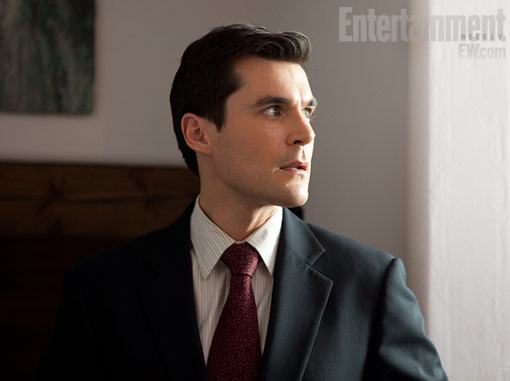
Maher as Don John. You work that suit, Simon!

Undoubtedly, Whedon’s production is going to be compared to Branagh’s ’93 film and only time (and a full review) can tell how it will hold up.  My initial impressions are better already – who wouldn’t take Sean Maher over Keanu?

Whedon’s choice in play to film is not unexpected given his canon.  He has long been attracted to strong female leads (“Buffy”, “Doll’s House”, “Firefly”), his humor is witty and quirky, and he seems particularly fascinated by soldiers and war stories.  For all of these things, Much Ado fits the bill.  I am particularly looking forward to Nathan Fillion’s performance of Dogberry and Sean Maher’s Don John (who will, with no doubt, overtake Keanu’s California surfer boy with the talent contained in his pinky finger… really, folks, it doesn’t take much to outstrip an actor with one feeling).

There are two things that makes me slightly nervous about the enterprise: one, there is no recognizable dramaturge working with Whedon.  While I don’t wish to belittle the intelligence of a man whose creativity and artistry I well respect, I will say that it is a haphazard move to work on a film of what is essentially a period piece without consulting someone who really knows what they are talking about.  To a modern director (especially someone working in film with what is traditionally a stage medium), a good dramaturge can be a godsend.  Who else is going to contextualize the piece within its historical and modern importance?  Who else is going to do the research as to what random words mean and how they should be presented?  Who else is going to deal with dimwit actors who can’t seem to find a grasp of the text?  Whedon isn’t a Shakespeare virgin, but even the best need some backup.  In an interview, Whedon confessed to some trepidation over the title “Much Ado About Nothing”.  “Well, I have nothing to say about nothing” he said.  Of course, after many re-reads of the script he realized that this title isn’t really what the play is about.  This sort of problem is precisely why you need a good dramaturge; somehow who has researched this stuff and can explain the connections.  Someone who can steer you clear of these misconceptions.  Someone who knows their Shakespeare, darnit!

My second bit of nervousness has to do with the relative inexperience of film actors with Shakespearean text.  I’m not saying that there’s no possibility of amateurs being brilliant, I’m just saying that without proper vocal and text coaching such things have proven in the past to be disastrous (just look at Leo and Claire in Luhrman’s film if you really want proof of a train wreck).

For that, I will be looking forward to seeing Wheedon’s directing style within this piece as

Amy Acker and Alexis Denisof as Beatrice and Benedick

well as a certain loyalty to the text.  Too often, hip American directors superimpose their vision and words over text which has, for hundreds of years, spoken for itself.  Whedon’s actors, while all amazing in their own right, have never struck me as the most disciplined lot.  It will be a true test of their worth to see how well they manage when a certain sort of freedom is stripped from them.  In addition, much of Whedon’s work relies upon acting between the lines; pregnant pauses, meaningful glances, physical humor unalluded to within the text of the script…  All of this must go with Shakespeare.  Shakespeare is entirely about acting on the lines.  There is no subtext in Shakespeare.  Everything you need to make a successful and entertaining production is right there.  Trusting the Bard is the only way to create a meaningful Shakespeare (lack of this, by the by, was Luhrman’s greatest failing).

If Whedon and his gang can overcome the desire to insert between Shakespeare’s text, I truly believe that this will be a film for the ages.

I am very much looking forward to seeing it.

Welcome Home!

Hello and welcome back to your regularly scheduled blogging at its spiffy new home, Daniprose.com!

After a hiatus during which my previously mentioned threat to pretend to be illiterate took full effect, I am back on the blogging wagon. I hope that the new site, in all of its glory, makes up for a least some of the lonely moments spent wandering the web searching fruitlessly for readable and amusing academicisms. The MA really burnt me out and I’m still re-fortifying for September, but I think I’m ready to swing back into gear and flex the writing muscles so that they don’t atrophy during my precious free-as-a-bird summer break.

Taking the leap to a real grown-up blog via domain name is something that I’ve been wanting to do for some time now. The impetus to hold my breath and jump came from a dear friend who (bless her heart) got excited at the idea of giving me wordpress tips. I figured that if someone else could get excited about my work, then I sure as heck could muster the force to push myself to the next level. I’m still working on tidying house, so you’ll see some little tweaks here and there for a few weeks yet, but on the whole I believe the site will remain pretty much as it is now.

A note on previous formatting: when I migrated the old stuff to the new site, there were a few formatting glitches (as you can see). While I do care about the presentation of my carefully-chosen prose, there are over one hundred entries on this site. Short of hand-editing each of them, I have not found a way to address these formatting issues. As such, I apologize in advance for them, but they will remain (unless someone can figure out how to effectively batch-change them).

So why “Daniprose”, you may ask?

“Prose – noun. 1a) Language in the form in which it is typically written (or spoken), usually characterized as having no deliberate metrical structure (in contrast with verse or poetry). 1b) That which is plain, simple, or matter-of-fact” (OED 3rd ed.)

Prose is language without meter or poetry. Prose is simple, colloquial. When Shakespeare wrote prose, it was generally for his rustic characters; the clowns, the mechanicals, the shepherds. Prose is language that breaks the rules of form. For an actor, prose is oftentimes deceptively difficult to work with since your regular Shakespeare tricks are useful only for the metered poetry. A passage of prose is riddled with wit, jokes, and nudges at the groundlings. It is to the point and cuts to the deep heart of any matter.

Some famous passages/monologues in prose:

Hamlet; Hamlet; III.i; “Get thee to a Nunnerie. Why would’st thou be a breeder of Sinners?…”
Henry IV ii; Mistress Quickly; II.iii; “Nay, sure, he’s not in hell: he’s in Arthur’s bosom, if ever man went to Arthur’s bosom…”
Macbeth; Lady MacBeth; V.i: “Out, damned spot! out, I say!…”
A Midsummer Night’s Dream: pretty much anything the mechanicals say, but famously Bottom IV.i: “When my cue comes, call mee, and I will answere. My next is, most faire Pyramus….”
Much Ado About Nothing; Benedick; II.i : “O she misusde me past the indurance of a block…”
Romeo and Juliet; Mercutio; II.iv; “More than prince of cats, I can tell you…”

Prose. The other white meat. And so, continuing on in the spirit with which we were founded, bending to Philip Henslowe’s frantic advice to a lovelorn Billy Shakes (“No, no, we haven’t the time… talk prose!”), with pen in hand we return to our hero’s saga and begin the prequel to Higher Education (Part 3): The Quest for the PhD.