Breaching the Breech

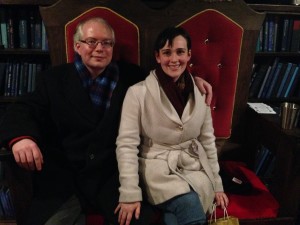
Earlier this week, I was able to attend a reading of Much Ado About Nothing presented by the Hub theatre company at Boston’s own Trident booksellers.

I’ve come to be wary of staged readings of Shakespeare.  By and large, I think that this forum works better for the tragedies (the comedies often rely upon too much physical humor/movement to make land in a staged reading, and the histories are already confusing enough without mixing in the complications of double-casting and no costumes).  For that, this was an enjoyable and low-key evening of theatre.

One thing that really got me thinking was the casting of a lady Leonato.  I’ve seen this trend developing lately (Actor’s Shakespeare Project cast a lady Duke of Milan in their Two Gents earlier this year).  We’ve seen in recent years (and I will blame this majorly on Julie Taymor) many female Prosperos, but to see this trend of making Shakespeare’s august noble characters in positions of power who are volleying politics by marrying off their daughters turned into women begs some complications that have to be re-examined.

Let me start off by saying that this has nothing to do with the quality of the acting.  So far, every august Lady I’ve seen in these roles has been fantastic.  But there are a few innate gender issues that you simply can’t escape when you have a woman playing a man’s role in this way.

I will limit my discussion here to Leonato because expanding it would get us into too-long-to-blog territory.

Even when we modernize Much Ado, was have to deal with a few dramaturgical truths.  Any “modernized” production of Shakespeare still needs to face the text because, well, you can’t ignore it.  If you ignore the text, why are you doing Shakespeare?

Dramaturgical truth the first: We’re in a world that has defined gender relationships.  This is made true by Beatrice’s show-stopping speech in Act Four.  She laments that she is powerless in her situation due to her gender.  As such, even if we drag the show into

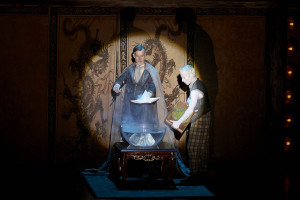
In case you're not sick of these shots yet; Rosalind and Touchstone from As You Like It... TALK about gender issues

In case you’re not sick of these shots yet; Rosalind and Touchstone from As You Like It… TALK about gender issues

“modern” or semi-modern times, we must still be in a universe with distinct gender boundaries.

Dramaturgical truth the second: We’re in a world where marrying someone is a play for political power.  We know this because of Leonato coaching Hero before the dance (“Daughter, remember what I told you: if the prince do solicit you in that kind, you know your answer”).  For that matter, we’re in a world with a very defined social hierarchy dealing with characters who have title and standing (A Prince, the Count Claudio, etc.).  Leonato is a part of this world; as a wealthy landowner he can host the Prince and his entourage and even seems to have some standing amongst them.  However, he is not blind to the opportunities which may present themselves while the Prince is a guest in his household.  Marrying his daughter to the Prince would do wonders for Leonato’s social standing and, while he’s not a cut-throat social climber like (for instance) Lord Capulet, he does have an awareness of society around him.

Dramaturgical truth the third: Gender relations and transgresses upon them make up a large portion of this play’s plot.  While we are dealing with wedding and wooing, the play’s major conflict also consists of Hero’s supposed trespass against her duties as a good daughter.  It is a very different scene when she and Beatrice are the only women onstage attacked and defended by the men around them than it is if Leonato becomes Leonata.  In the first case, we clearly see the gender divide that Beatrice laments in the scene to follow.  In the second, we wonder why it is that Beatrice can’t fight the gender roles just as Leonata did and assert her own authority.  In this way, giving Leonato a sex change very clearly negates Shakespeare’s text.  It gives us a world that no longer makes sense, a world that fights the text itself.  Unless a director can find some way to extratextually justify Beatrice’s speech, an audience is left wondering what the big deal is.  And, honestly, any play which needs to make extratextual additions or clarifications is edging into shooting Horatio territory.

Dramaturgical truth the fourth: By making Leonato a woman, we are left with a few historical heritage questions.  Though it’s true that a woman who had become a widower would have been allowed to keep her husband’s estate and have some power over running it, pretty much any man who came along could have found some way to run rampant over her power there and disenfranchise her.  In Much Ado, we have several examples of power hungry men who have everything to gain from Leonata’s estate (the most ready example is Don John the Bastard who could just as easily have ruined everyone’s plans by semi-force-wedding Leonata as he did with his elaborate bed-trick scheme… also: the wedding would have been more permanent).  By making Leonato a woman, it leaves unnecessary loose ends.  Does Leonata end up with Don Pedro at the end (it’s the easiest solution to Benedick’s closing suggestion of “get thee a wife”)?  This director made that particular choice, but that particular choice has its own complications.  What does that mean to the government of Messina?  What does that mean to Leonato’s estate?  Has Claudio then, thereby, inadvertently become much more than he deserves by wedding Hero?  Does this mean that Don John is going to now target Leonato’s line in the obviously ensuing war since Leonato, Hero, and Claudio now stand between himself and his brother’s kingdom?

I think, at this juncture, I’ve sufficiently proven my point.  Cross-gendered casting is not something to be taken lightly (even if you have an awesome cast!).  In the event that you would like to proceed with something like this, make sure you also have an awesome dramaturge to help you think through these issues before you give some poor theatre scholar a headache.  If you don’t have an awesome dramaturge, I happen to know one (hint: it’s me).

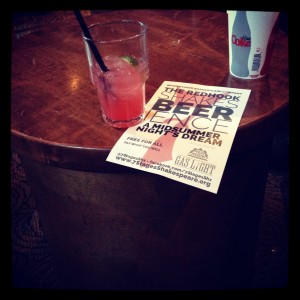
This is only the first in a series of readings that Hub is putting on this summer at Trident.  They’re calling the series Beer+bard and despite my over-thinky nit-picks, I do highly recommend that you check them out.  The next is going to be Henry IV i on June 17th at 7PM; come hungry for food and Shakespeare!

Happy Birthday, Will!

Tuesday was Shakespeare’s “birthday”.

I put “birthday” in quotation marks because, much like most things Shakespeare, we don’t know precisely when the man was born.  Early modern birthing and burial practices being what they were, we can hazard a guess.  Since April 23 is as good a day as any, it pleases us to tell ourselves that this is the day upon which our Will was born and, as such, we should celebrate him on that day.

To celebrate, I was invited to speak on a panel by New Hampshire’s Seven Stages Shakespeare company.  The panel was held in the most adorable little bookshop in Portsmouth (Riverrun books) and consisted of a wide array of experts: Hope Jordan, the first official slam poet master in New Hampshire; John-Michael Albert, Portsmouth’s outgoing poet laureate; myself; and a much more senior Shakespeare scholar, Dr. David Richman.  Our conversation was focused on The Phoenix and the Turtle, the role of poetry throughout time and poetry in general, but what it really made me do was remember my roots as a Shakespearean.

I’m certain that by now anyone who follows this has 100% assurance of my devotion to Shakespeare as a lifestyle.  This life choice is a debt that I owe to my amazingly brilliant Grandmother who decided that no grandchild of hers would be bad-mouthing the bard and made it her business to forcibly subject me to well-performed pieces until I learned to love them.  Since then, I’ve used her method several times on others whom I’ve wanted to instill a similar Shakes-beat into and I’ve actually found that this is the best way to convert the unfaithful.  There is, without a doubt, something about Shakespeare that touches us as human beings and, while reading it can be dull and unfulfilling, seeing it performed by anyone who has an ounce of sense and talent is something the human heart can’t forget.  We’re beings of music and stardust, metaphor and poetry.  We’re beings of emotion: love and anger, jealousy and hate, yearning and hope.  It’s all in there; every last bit.  Anything you could want or hope to feel as a human is something you will find in the canon, it’s simply a question of knowing where to look.

It would be strange of me to try and explain how Shakespeare has affected my life since I live every moment with the man.  Would I have a life without Shakespeare?  Well, sure, but it would be a completely different life.  He’s managed to creep inside my soul and speak from the darkest places there.  But here’s the thing: the more I learn about Will, the more I realize this fascination isn’t one I feel alone.  Throughout history many great men and women have felt the same; I’m in the company of Goethe, Jonson, Müller.  I’m in conversations with John Quincy Adams, Isaac Asimov, and Neil Gaiman.  I’m haunted by Voltaire, Sarah Bernhardt, and John Keats.  Shakespeare studies is inclusive; it touches just about every other major course of literary study to some extent, and it’s written all over the history of the theatre.  Because of Shakespeare, I have something to talk about with most people in my extended field (both the arts and humanities).

Shakespeare’s the great communicator and the great equalizer.  When I need to say something but can’t quite find the right words, I often turn to him for help.  When I am feeling something overwhelming, I often remember how his characters dealt with similar feelings (…though generally refrain from enacting their often bloody and complicated solutions; I have enough trouble in my life without running mad, baking people into pies, or crafting over-engineered schemes to manipulate the people around me and then wondering why they don’t work/how they could have possibly worked so well).  Shakespeare’s there at my best and my worst and, these days, is often the catalyst for such moments.  I rely on him to be a constant source of inspiration; a heartbeat to my work.  He’s with me at every conference and he’s coached me through the end of every semester.  When I feel like giving up, he alternates glowering at me and encouraging me.  He keeps me motivated and excited.  He calls me back when I’ve wandered too far astray, and he tells me to play the field when I’m being too clingy.

Shakespeare, right now, is my life.  And I am so grateful to have the opportunities which allow this.

Here’s a few snippets of the panel.  Watch, enjoy, and bid a big happy birthday to my man Will.  Also, if you were interested in how some other internet denizens have chosen to celebrate Shakespeare-day, you should check out the e-card that the Shakespeare Birthplace Trust put together with folks around the world (myself included) available here.

[youtube http://www.youtube.com/watch?v=k_9SeokUWNU]

[youtube http://www.youtube.com/watch?v=-JOw1Rd4sW0]

Finals und kein Ende

This morning: I had a conversation with Hamlet on twitter about Goethe while reading snippets from Wilhelm Meisters Lehrjahre about a character performing Hamlet.

This sprang from my new favorite quote from Goethe “Away with your fat Hamlets!”

…what I was really doing was preparing a handout for an in-class presentation/facilitation/thingie I have to give on Thursday (one of the two big semester projects still on my docket).

Over the course of preparing this handout, I also discovered that the snippets of Macbeth I had chosen as an object lesson in early German Shakespeare translations for my class were perhaps not entirely what I had previously thought.  When one of my sources discussed the Schlegel translation of Macbeth pretty heavily, I assumed this may be a good example of how the Germans during this time period weren’t quite getting the language as we English-speakers expect to receive it.  I pulled a snippet from Macbeth’s “whence is this knocking?” speech from the 1764 Wieland translation, then same from what I thought was part of the 1801 Schlegel translation (highly regarded as the best rendition of Shakespeare into German from the time).  I re-translated them to English as best I can (because, despite any pretentions to the contrary, graduate students don’t actually know everything), and set them prominently on my handout.

…only to find out that the textual history of the Schlegel is WAY more complicated than I

Finals has done this to me.  That's will riding a horse my grandfather carved while waiting to be sent home during WWII

Finals has done this to me. That’s Will riding a horse my grandfather carved while waiting to be sent home during WWII

had thought (hey, at least I discovered this BEFORE my presentation on Thursday).  Not to bore you with details, but it’s actually a rather cool thing since Schlegel winds up collaborating with Tieck but despite this his translation of the complete works remains unfinished until Tieck’s daughter takes it up.  So apparently what I have is a kind of proto-feminist text that my inner English geek could analyze up the wazoo but, since I’m in a theatre department, should probably refrain from doing so.

Anyway, once this is done then I have a paper to write (that I’m nowhere near as prepared for as usual but thankfully have more time than I thought I would have so… it may just balance in the end).  Then, on May eighth, I turn in that last stack of pages, breathe a sigh of relief, and take a few days to a week off before I start studying for my comps like a mad person.

And at some point in the near future, it’s going to hit me that to complete this semester’s projects I had to do research in a language that I didn’t know a single word of before last June and, moreover, I’ve been routinely walking around with a bagful of books in three different languages (none of the pig Latin)…  Not to brag, but you’ve got to admit that that’s pretty cool.

On that note, I think I’ll put down the Goethe and turn to Molière for a bit.  Because apparently I like pain.

Gird yourselves.  Finals are here.

Afterwards

It’s difficult to know what to say in the wake of tragedy.  This kind of thing effects different people in different ways and, not being someone gifted/cursed with a great deal of empathy, it’s double difficult for me to come to any conclusion about something appropriate to relate.

The last lines of Shakespeare’s tragedies are generally attempts by his very human characters to break the impossible tension of the play’s events.  Often these words are uttered over a stage strewn with corpses; the trail of ruin that true tragedy leaves in its wake.

Instead of trying to come up with something to say myself, I thought I’d take a moment to survey these lines for you in hopes that they will provide something more profound than any axiom I could utter.

Stay safe, everyone.

“My rage is gone;
And I am struck with sorrow. Take him up.
Help, three o’ the chiefest soldiers; I’ll be one.
Beat thou the drum, that it speak mournfully:
Trail your steel pikes. Though in this city he
Hath widow’d and unchilded many a one,
Which to this hour bewail the injury,
Yet he shall have a noble memory. Assist.” –Aufidius, Coriolanus, 5.6

Aufidius, seeing Coriolanus dead, feels sorrow for his nemesis.  His tenderness towards Coriolanus and willingness to honor his mortal enemy in death shows a true humanity to Aufidius; the man, not the soldier, closes this show.

“Let four captains
Bear Hamlet, like a soldier, to the stage;
For he was likely, had he been put on,
To have proved most royally: and, for his passage,
The soldiers’ music and the rites of war
Speak loudly for him.
Take up the bodies: such a sight as this
Becomes the field, but here shows much amiss.
Go, bid the soldiers shoot.” –Fortinbras, Hamlet, 5.2

This one has given me particular cause for ire over the years due to directors purposefully misinterpreting it to mean “take Horatio out back and shoot him”.  I’ve already expounded upon why this is a bad idea so I don’t feel the need to hammer it home here.

“The weight of this sad time we must obey;
Speak what we feel, not what we ought to say.
The oldest hath borne most: we that are young
Shall never see so much, nor live so long.” – Albany, King Lear, 5.3

Perhaps the most profound of the end-tags; I’ve always had a special fondness for this one since it can apply to not just a tragedy, but also to many other aspects of life when politics is involved.  For example: it was an utterance first delivered me by a professor when we were in conference before a talkback with an important director whose work we had just seen.

“Gratiano, keep the house,
And seize upon the fortunes of the Moor,
For they succeed on you. To you, lord governor,
Remains the censure of this hellish villain;
The time, the place, the torture: O, enforce it!
Myself will straight aboard: and to the state
This heavy act with heavy heart relate.” – Lodovico, Othello, 5.2

Lodovico’s instinct to take charge of the situation and his burden to inform the people of what has transpired is a burden that many leaders will feel during such times of crisis.  Having to stay strong for other people makes us strong within ourselves.  Lodovico, rather than break down completely, takes it upon himself to be a pillar for the people.

“A glooming peace this morning with it brings;
The sun, for sorrow, will not show his head:
Go hence, to have more talk of these sad things;
Some shall be pardon’d, and some punished:
For never was a story of more woe
Than this of Juliet and her Romeo.” – Prince, Romeo and Juliet, 5.3

Perhaps one of the most famous last lines, owing perhaps to the Reduced Shakespeare Company’s Romeo and Juliet portion of Complete Works of Wllm Shkspr [abrgd]…. Or maybe that’s just how I remember it.

My most profound sympathies go out to the people effected by yesterday’s events.  Stay strong, Boston.

Scene-Swapping

For reasons that may or may not have anything to do with a certain production of Twelfth Night which I’m currently working on (you should come see it, by the way), I’ve been putting a lot of thought into the re-ordering of scenes in contemporary performance of Shakespeare’s work.

Specifically in the performance of Twelfth Night, the first and second scenes of the first act are often inverted in performance.  For whatever reason (and these reasons differ with theatre companies/directors), theatre-makers feel that it’s sometimes appropriate to re-organize these two scenes.

The opening scene of Twelfth Night as it appears in modern editions depicts the Count

Rehearsal: a still life

Rehearsal: a still life

Orsino at his court in Illyria lounging melancholic across the stage as he orders music played for him and pines for the love of the Countess Olivia (the first lines of this scene is the resounding “If music be the food of love, play on…”).  The second scene shows us Viola crawling onto shore after her shipwreck and asking “What country, friends, is this?”.

The opening lines of Shakespeare plays always tell you something about the play.  In the case of Twelfth Night, the show is steeped in music.  Twelfth Night is a show which examines the effects of music on human beings and Orsino’s court is a place where music is constantly straining in and out in the background, filling the edges of the senses.  Orsino calls music “the food of love” and does, in fact, seem to feed off of it for the entirety of the show.  When the music stops, Orsino is awakened to the harsh realities of life outside his court.  His veil of melancholy and self-delusion is lifted, and he finally sees things for what they are.

Orsino speaks the opening and closing lines of the show (…with the exception of Feste’s song which I would argue does not fall into the category of “speech” so we cannot classify it as the “last lines”).  It’s not often that Shakespeare bookends his shows this way and thus we should take special note of the move in Twelfth Night.  Orsino at the beginning is very different from Orsino at the end; everything and nothing has changed.  This is highlighted by his words and the impetus to speak them and through this the audience is forcibly confronted by the journey which Orsino has taken through the course of the show.

By having the first scene occur in a world and a story already in progress, Shakespeare establishes and highlights that world.  We are shown Illyria and how wacky it can be before the play’s outsider (Viola) enters that world.  It establishes something before fully explaining it; allows the audience to encounter an oddity before the oddity is laid before them in its full detail and glory.  In a way, it shocks an audience into paying attention.  It’s a lot easier for a modern audience to glaze over the lengthy descriptions which populate I.ii than it is for them to ignore the pining Count in I.i.

More rehearsing

More rehearsing

Perhaps most importantly, bending a script to one’s will is the cheater’s way out of solving an acting problem.  If you, as a director/company don’t think that you can deal with the script Shakespeare wrote, then don’t perform Shakespeare.  When an actor encounters a problem, he doesn’t simply change the line to fix that problem; he gets creative.  Shakespeare’s text should be treated with the same integrity.  Now granted, I do think that there is a certain amount of cutting that goes into any healthy modern production of Shakespeare’s text.  I’m also not completely averse to changing small words for the sake of clarity (just make sure you check it with your dramaturg first).  I have even enjoyed productions that played fast a loose with the text; but this sort of thing takes a great deal of care and experience.  As a general rule, don’t re-arrange Shakespeare.  Just don’t do it.  It’s sloppy, tasteless, and gives purists like me a headache.

In the interest of full disclosure, the group decided to swap I.i and I.ii in our production (on a day when I wasn’t there to dissent).  I have made the full extent of my discontent with the decision known and have no plans to censor my opinion about this issue.  Despite this lapse in judgment, the production is a solid one with a lot of fun and energy and I highly recommend you come see it (if for no other reason than now you can snob out the egregious violation of textual integrity innate in the aesthetic choice of scene-swapping).

Measure still for Measure

For those who have been following the saga, Measure for Measure opened on Thursday.  At this point, it’s nearly halfway through a two-week run.  I was there to see the show opening night and, let me tell you, that was an interesting feeling.

I’ve been living with this project since last April when I sent an introductory e-mail to the director.  Over the course of June/July, we spent a great amount of time cutting the script and crafting an acting edition (the first time I’ve ever had the chance to do this).  Her goal was for the show to run two hours.

It ran two hours on the dot with a fifteen-minute intermission.

Getting prepped for final dress; you can see that I was eagerly telling such to my twitter feed

Getting prepped for final dress; you can see that I was eagerly telling such to my twitter feed

Since June/July, my level of involvement has ebbed and flowed.  I team-taught a text workshop to the cast (along with my colleague who was ADing the show) to get them acquainted with the language.  I called it the “quick and dirty method to opening up Shakespeare for actors who have never studied him before”.  Who says brevity is the soul of wit?

For the most part, it worked.  The product was definitely not conservatory-level, and there are notes I still would have given, but art is art and art is never finished nor is it ever completely satisfying to the true artist.  On the whole, it was a show which I enjoyed (and that’s saying something; anyone who follows this blog can attest to how harsh a critic I can be), a show which I was proud to present to my cohorts, and a show which I had the opportunity to see grow from a seed of an idea to a fully-mounted production.  That is a process which is always satisfying.

Over the course of working on Measure, I would occasionally get e-mails asking not-so-random (but sometimes seemingly so) questions.  Do Catholic churches ring out the time?  How long does it take to become a nun?  What does this word/sentence/phrase mean?  Some of these questions are things I could have predicted (seriously, “Prenzie”?), some of them I never would have imagined.  But that’s part of what was so exciting about this; in working closely with the text and the director, I had the opportunity to come to new understandings about a show I (honestly) hadn’t put overmuch thought into before.

One of the tasks which I enjoyed the most was crafting a timeline of the action.  When does this scene happen?  How much time passes between Act I and Act V?  (…the answer, for those who are curious, is somewhere between six days and three weeks depending on how much time passes between when Angelo takes office and when Claudio is arrested.  After I.ii, the rest of the play’s events occur over the course of five distinct days).  It was gratifying to be able to sift and sort the text and make some sense of it in a useful, tangible way.  This, ideally, is what my job would always be like; someone has a question which needs answering, they ask that question of me, I go through what I know best and find an answer.  Alas, if only everything were so simple!

My partner in crime, who was able to attend opening with me, told me he saw my fingerprints on the show.  That, if nothing else, is perhaps the most gratifying part of my job.  I also received a lovely e-mail from our department chair complimenting my work on the essays in the show’s program (double wonderful since those essays gave me such a headache when I was working on them).

2013-02-14 20.00.10

Opening night. Yes, I know, the set looks basically the same from final dress. Sorry for the redundancy!

So, I declare my first official project as a dramaturg to be a success.  I thoroughly enjoyed the process (even if sometimes it kept me up at night… literally.  I was up until 2AM the night before opening sending out notes to actors) and will gladly do it again.

…maybe after a little break though.  Twelfth Night is relatively time consuming and I do need to catch up on the desk-piles again.  I really wish my papers would start writing themselves.

Games People Play

I have a confession to make.

I play games with myself.

You know when you’re waiting for something or someone?  In those moments when you’re sitting in a stupid meeting that doesn’t really require your attention but does require that you at least look like you’re paying attention?  When you are sitting somewhere unexpectedly and forgot to bring a book or something else to do?

In those moments, to push aside the implacable boredom, I play one (or several) of the following games with myself:*

not sure if I've introduced you to the latest addition to my desk ornaments; mini Will!

not sure if I’ve introduced you to the latest addition to my desk ornaments; mini Will!

 1)   I list Shakespeare’s works in alphabetical order.  You would think that after years of doing this I would have the entire list memorized but, alas, my Swiss-cheese brain still requires kicking to churn forth these facts.  I do know them, just not always in alphabetical order.  I should make up a song or something a la the animaniacs…

 2)   Once I have that list (which, generally, I will write down as I go), I go through and try to recite the first line of each play.  Some of them I have down cold (“Two households both alike in dignity”; “when shall we three meet again? In thunder, lightening, or in rain?”; “Now is the winter of our discontent made glorious summer by this son of York”), but there are others that aren’t quite so famous.  Tell me the first line of Timon of Athens.  Go on.  Someday I’ll have them all committed to memory…

 3)   I will go through and recite (or at least call to mind) the most famous speech (or, sometimes, just a speech) from each play.  If I don’t know one, I make a mental note to learn one at some point in the near future.  Sometimes this resolution sticks better than others.  I do have a speech from most of the most famous plays at least, and some of the more obscure ones.  That ought to count for something.

 4)   If I’m feeling particularly perky, I will recite the last line of each play.  This one is significantly harder though, again, there are a few that will always stick with you (“The weight of these sad times we must obey, speak what we feel not what we ought to say, the oldest have borne most; we that are young will never see so much nor live so long”; “That’s all one, our play is done, and we’ll strive to please you everyday”; “When I make curtsey, bid me farewell”).

 So there you have it.  If, in the near future, you find yourself speaking to me and my eyes get kind of glazed over, you have a pretty good idea of what I may be doing in my head.  That or re-playing episodes of The Muppet Show, it’s kind of a 50/50 shot at this point depending on how brain dead I’m feeling from whatever research endeavor I’m currently working on.

*admittedly, I stole some of this from RSC director Dominic Dromgoogle and the methods he documents utilizing to pass the time as he traversed the English countryside while walking between London and Stratford in his memoir Will and Me.  It’s a clever little book and gave me a plethora of demonstrations of how I’m not nearly as nerdy about Shakespeare as I could be… so I promptly then became about 10% nerdier.  In any case, the book is very entertaining and I highly recommend that you check it out.

Super-Secret Mystery Project: Revealed!

It was officially made official last week so I can now officially tell you what all this hulla-ba-loo about my super secret project is about:

I’m working on Twelfth Night.

And it’s not just any Twelfth Night.

 When we finished As You Like It, a few of the cast members and I felt like-mindedly that A) we didn’t want to stop working on Shakespeare, B) we had learned a lot from this process and we wanted to continue learning from each other, and C) we had some ideas about how to create theatre that existing companies may not be comfortable with.

One idea that I have been kicking around for many years is this: can you create theatre without a director?  Do you need a single guiding vision in the room, or is a roomful of smart, talented people a viable alternative?  Can you collaborate one what should be a truly collaborative process?

Apparently, I’m not the only one.  My cohorts felt similarly; too long oppressed by the

Myself and my best gay will be playing old friends once more; he's taking on Feste amongst other roles

Myself and my best gay will be playing old friends once more; he’s taking on Feste amongst other roles

tyranny of ego-driven directors, we struck out on our own to try an experiment.  We wanted to create a dynamic company driven by a mutual passion for Shakespeare and a burning desire to produce his work.  We wanted to create an environment where we could learn from each other equally and where one voice wasn’t necessarily the presiding one.

A few networking connections later and we had begun rehearsal.  Due to the brilliance of one of my compatriots, the show’s been cut to two hours and is being performed with (get this) eight actors.  We’re all doubling roles in one way or another and this has led to a rollicking good time at rehearsal.  Twelfth Night is already a fun show, but pile on top of the innate humor some great ensemble work and meta-theatrics and you’ve got yourself a real winner.  I always leave rehearsal more excited than I was when I walked in, more energized than I was when I walked in, and more impatient to see the end produce than I was when I walked in.

In short: you should come see our little experiment in action!  We’re calling ourselves (at least for now) the “What you Will Players” and we hope to be taking the Boston theatre scene by storm.  Our guiding values are community, engagement (with the audience and the text), enlightenment (of ourselves, each other, and our audiences), and simple performance done simply.  We’re not into bells and whistles and Twelfth Night will be performed largely using costumes and props that we found in our basements and closets.  We’re hoping to show that good Shakespeare doesn’t need the trappings of theatrics

the last time I was in Twelfth Night I played Antonio/the Sea Captain... you know... coz I'm a big scary pirate.

the last time I was in Twelfth Night I played Antonio/the Sea Captain… you know… coz I’m a big scary pirate.

layered on top if it, but rather (simply) a genuine emotional connection.

I’ve worked on Twelfth Night before.  I’ve done monologues, scenes, and even the entire show.  This is the first time that I’ve really felt connected to it, however, rather than distanced from it.  In fact, the last production of Twelfth Night that I was in was the one that made me run screaming from the theatre due to an awful director, his ego-driven antics, and his inability to communicate with me as an actor.  My current rehearsal process is slowly curing me of my Twelfth Night phobia and I can honestly say that this show is going to be a real treat to see.

…so who am I playing, you ask?  Through some exceedingly clever script cutting and some crazy quick changing, I’ll be appearing as both Maria and Olivia.  Can you already tell how much fun this is?

Updates to follow in the coming months!  We will be performing March 8th and 9th at 8PM and 10th at 3PM at the Winthrop Under-Playhouse Blackbox (60 Hermon St., Winthrop MA) so mark your calendars.  Ticket info will be available very soon!

A Shakespearean Dramaturge’s Lament

Okay, fine, I’ll admit it.  While pinterest has done many wonderful things for my life (I have yet to find a recipe on there that isn’t absolutely mouth-watering), it has caused one bone of deep contention between myself and the internet.

The internet is the new vaudeville.  Anyone can put anything on it.  Sometimes these things have worth (in entertainment value, educational insight, or just general human connection), and sometimes they don’t.  What pinterest has made me keenly aware of is the proclivity of “quotes” on the internet.

I say that in quotes because, in my experience, most quotes on pinterest are either misattributed, made up, or just plain wrong.  Since a quote’s value lies in the validity of its speaker (if it didn’t, we’d just call them “words” or “phrases”), such mistakes render the quotes useless.  Or, if not useless, just a collection of words that anyone could have uttered.  And, really, who wants a collection of words said by no one? It’s like wearing a fake Tiffany’s bracelet and calling it the real deal (all zazzle and no genuine maker’s mark).  It’s like eating yogurt with aspartame in it (all appearances and no substance).  It’s like reading an abridged version of a classic novel (all editor’s opinion and no true literary value).

Perhaps most disturbingly, this trend feeds into the mindless trope of unwary internet denizens that everything one finds on pinterest is true.  Even the savvy surfer can be taken in by pretty words and a big name.  And this, my friends, discourages critical thinking, encourages false facts made true, and overall proves a thorn in the side to those of us who know better who now have to content with gaggles of would-be quoters.

I could have let it slide if not for the constant misattribution to Shakespeare.  Oh, sure, it happens all the time.  Just about everyone in the field of space and time ever has made a mistake like this.  But I’m not talking about the little mistakes, I’m talking about the ones that grow and propagate and sell themselves on t-shirts.

The plays attributed to Plautus are divided by the Roman philologist Varro into three categories: those definitely by Plautus, those possibly by Plautus, and those most certainly not by Plautus.  In that vein, I would like to present to you a list: famous quotes definitely by Shakespeare, famous quotes that are kind of Shakespeare’s, and famous quotes definitely not by Shakespeare.

Famous Quotes Definitely by Shakespeare

“The course of true love never did run smooth.” – Lysander, A Midsummer Night’s Dream, 1.1

“To be, or not to be: that is the question.” – Hamlet, Hamlet, 3.1

“Friends, Romans, Countrymen, lend me your ears.” – Antony, Julius Caesar, 3.2

“All the world’s a stage, and all the men and women merely players; They have their exits

The Great Globe itself

The Great Globe itself

and their entrances; and one man in his time plays many parts…” –Jacques, As You Like It, 2.7

“If you prick us, do we not bleed? If you tickle us, do we not laugh?  If you poison us, do we not die? And if you wrong us, shall we not revenge?” – Shylock, Merchant of Venice, 3.1

Famous Quotes Kind of by Shakespeare

“Alas, Poor Yorick; I knew him well.”

This is one that’s almost Shakespeare.  The history of this misquote is something that would take a lot more digging than I’m prepared to do at the moment to dredge up, but we all know the classic scene from which it comes.  Hamlet finds the gravedigger comically going about his rounds and, upon grave-digging Ophelia’s final resting place, uncovers Yorick the Jester’s skull.  Hamlet takes the skull and famously laments, “Alas, poor Yorick!  I knew him, Horatio.  A fellow of infinite jest, of most excellent fancy.  He hath borne me on his back a thousand times.” (Hamlet, 5.1)

If I had to guess, I’d say that some pop culture thing or other had, at some point along the way, need to utilize a Hamlet reference without another character onstage and, so, they altered the quote.  Unfortunately, since pop culture sticks, the misquote has as well.  Fight the system!  Quote Hamlet with integrity!

“This above all: to thine own self be true.”

One of my near and dear friends, when he was eighteen and stupid, went and got this tattooed on his body.  Ten years and one Master’s in English later, he was regretting the decision for this reason:

The problem with this quote isn’t the wording (the words are accurate), it’s the sentiment.  Though Polonious does say this to his departing son, it’s perhaps the least sincere section of the play.  Context is important.  Divorcing a quote from its context strips it of power.

We’re all guilty of doing this; everyone from Christmas card manufacturers to political speechwriters.  The authority of The Bard is unquestionable (thanks mostly to David Garrick) and, because of this, he’s called upon to support just about anything you can think of even when his words are removed from their greater context and, thereby, just words.

“Some are born great, some achieve greatness, and some have greatness thrust upon them.”

See above problem.  This quote, taken as one of the greatest utterances of the English language, is part of a letter written by a bunch of gamboling drunkards to trick a pious (if cranky) man into thinking that his employer is in love with him.  Hardly heroic words to live by, even if they are wise.

Sonnet 116

If I hear this read at one more wedding, I’m going to stand up and loudly declare the marriage invalid on the grounds of literary stupidity.  People, seriously, if you want something said at your wedding, funeral, or any other event of note, at least do your friggen research.

This poem isn’t a declaration of true love, nor an uplifting statement about how love is eternal and beautiful, but rather the words of a man upbraiding an untrue lover and telling the subject how things should be.  It’s Shakespeare saying: “if you were true loves, I wouldn’t speak these words to admit impediments, but obviously you’ve got some misconceptions about love… lemme clear those up for you.”

Really?  You want that read at your wedding?  Monkeys.


Shakespeare disapproves

Shakespeare disapproves

Constructions of the Internet; NOT SHAKESPEARE

“You say that you love rain, but you open your umbrella when it rains.  You say that you love the sun, but you find a shadow spot when the sun shines.  You say that you love the wind, but you close your windows when the wind blows.  This is why I am afraid, you say that you love me too.”

What, what, what are you doing?  First of all, this doesn’t fit any of Shakespeare’s meters.  Not a one.  So that would relegate it to a section of prose from one of the plays.  Okay, maybe.  There is some love-content written in prose (none of it would be this intense, but… sure, let’s go with it for a moment)

But let’s look at this a little more closely: the word “umbrella” is perhaps the biggest give-away.  It doesn’t enter the written vocabulary of the English language until 1609 coming from the Italian “ombrella” which is from the Latin “umbra” meaning “shade” and, at first, was used specifically to reference a means of shelter or protection.  It wasn’t used to speak about a portable version of this until 1611, and then it referred specifically to a sun shield (the early ones were made of leather and wooden hoops).  Not until 1634 do we have record of its usage as a word to describe an item used to protect against the rain.

Shakespeare died in 1616.  His last plays were written around 1613, but certainly no later than 1614.  Do you see the problem here?

NEXT!

“When I saw you, I fell in love and you smiled because you knew.” 

This one drives me nuts.  I really don’t know who started it, if it was a mistake, or if they were purposefully trying to give a poor Shakespearean a hernia.  This quote is MISSATRIBUTED; Shakespeare never said anything like this.  Not even anything I can bend to make fit this.  The quote is actually the work of Italian poet Arrigo Boito who did, granted, write the libretti for Verdi’s Otello and Falstaff… please PLEASE stop sharing this one around without giving the poor guy some credit.  Harumph.

“Expectation is the root of all heartache.”

I have no idea where this came from; it’s another internet construction with no basis in reality (much like the bonsai cat).  The word “heartache” only appears once in the canon (“by a sleep to say we end the heartache and the thousand natural shocks that flesh is heir to…” Hamlet, 3.1).  The word “expectation” is slightly more prolific and appears 26 times, but never in a context that is remotely near to what this quote is trying to say… it’s not even written in iambic.  This is clearly trochaic; a meter only used by Shakespeare’s magical characters (like Puck and the Witches), certainly not by any lovers ever….  HARUMPH!

To Conclude…

Before you go believing things on the internet, tattooing things on your body, or uttering words at important life-celebrations…

FIND YOURSELF A DRAMATURGE!

Another Openin’, Another Show

This week past was a great theatre-going week for myself and my ever-wonderful partner in crime.  There are some exciting things happening in Boston right now and it has been a pleasure to see some of them.

Pippin at the ART 

The American Repertory Theatre as an institution seems to be undergoing some changes; though no longer a center for the avant-garde (as far as I can tell, this has now been relegated to their secondary venue the Oberon), they still produce some pretty exciting theatre.

Right now on the main stage, you can see a bold new staging of Pippin.

Press Shot for Pippin

Press Shot for Pippin

Alright, alright, it’s Pippin.  Yea, the show itself is about as schmaltzy as they come.  But honestly, what’s life without musical theatre schmaltz?

And this staging really brings something to the text.  Dianne Paulus enlisted the assistance of circus choreographer Gypsy Snider to present a show that’s loaded with spectacle, drenched in theatricality, and definitely somewhere the audience would be tempted to run away to.  The choreography is new, but Chet Walker definitely kept the Fosse feel and there are plenty of shoulder-rolls and arm-fans to go around.

Of course, the show stopper (and show-stealer) occured late in the first act (Andrea Martin’s Berthe gave a performance of “No Time at All” that I am hard pressed to ever forget).  Matthew James Thomas’ Pippin is petulant and angry, wide-eyed and hungry, essentially the perfect blend of youthful optimism and teenaged angst.

The only performance which I found even slight fault in was that of Patina Miller as the leading player.  While Miller is an amazing dancer and her vocals can’t be beat, she lacks the undercurrent of menace that the part requires.  If she were to truly dig and find some semblance of an inner villain, the show would be well near perfect.

The finale lacks some sizzle (I’ve been told due to fire codes, or potentially expense), but really.  What are you going to do with a show that asks you to set people on fire?  From my vantage point second row center, the effect looked cheesy and glitzy (which would have worked had it not been for the plot-point about Pippin ACTUALLY setting himself on fire).  I’ve been told that it doesn’t look as awful from further back in the house.

I’ve also been told that Paulus made the exciting announcement at the show’s opening the other night that it would be making its way to Broadway next.  I am extremely pleased to hear this.  I highly recommend you get out to see it now while tickets are cheap(ish) and the show is local.

Two Gentlemen of Verona by the Actor’s Shakespeare Project

I’ll admit, I didn’t go into this performance with high expectations.  There’s a reason that Two Gents is rarely performed.  Act Five is a nightmare to make read to a modern audience, and the show’s protagonist is one of the least likeable characters in the canon (for further discussion of this, check out our recent podcast about it).

Two Gents promo art

Two Gents promo art

In addition, I’ve never yet heard a good review of an ASP production.  None of my local friends (or mentors) have been impressed with their work, so I did not expect that the combination of these two deadly things would yield anything horribly impressive.

For that, Two Gents is one of my favorite shows and I’ve always wanted to see it done.  Despite myself, I was rather excited to find out what the good folks at ASP had come up with.

First things first: I know Bill Barclay’s work from his long tenure at Shakespeare & Company (some of this while I myself was there training).  The man’s a genius.  His abilities with music are unmatched and it’s always an absolute joy to watch him romp about the stage with his own one-man-band of instruments (in this show alone, you can see him play the guitar, concertina, accordion, ukulele, and harmonica along with an assortment of percussion noise-makers).  I expected the music to be outstanding.

Barclay’s performance was equally impressive.  Protheus is an extremely difficult part to pull off since it requires a wide range of emotion very quickly (he’s one of the least mature men in the canon), and the foreknowledge that the audience is going to hate you.  Barclay’s natural charm and charisma worked to offset this, and his command of the text meant that he got every ounce of emotional connection out of the role.

Unfortunately, he was in the minority.  The women onstage were less impressive – Paige Clark (Julia) went for shtick over emotion, and Miranda Craigwell (Silvia), though stunning, didn’t seem to make any acting choices at all.  Marya Lowry made an excellent gender-bent Duke (Duchess) of Milan, but her Lucetta was frantic and muddy.  This is doubly unfortunate since the women are the true heart of this show; without a deep connection to Julia, the audience has no reason to react to Protheus (though Barclay’s charisma covered a multitude of sin).

The clowning was spectacular.  Thomas Derrah as Speed and John Kuntz as Launce were precise, efficient, and uproarious.  They counter-balanced each other admirably, and entertained thoroughly.  They were aided in this endeavor by Bruno, the most well behaved dog I’ve ever seen, in the role of Crab.  To quote Geoffrey Rush as Philip Henslowe, “You see – comedy. Love, and a bit with a dog. That’s what they want”.

ASP solved the act five fireworks with a game of bardic footsie that I can only describe as “admirable”.  After menacing the outlaws, Protheus turned to Silvia, made his threat, then realized what came out of his mouth.  Disgusted with himself, he dropped his knife, fell to his knees, then wrapped his arms around Silvia’s waist in a pathetic act of self-reproach.  Enter Valentine who sees something more than what he sees (as a lover is wont to do).  For a modern audience, I think this is the only way to make the scene read if you still want to maintain any sense of empathy with Protheus in the end.  It ensures that Protheus remains redeemable without violating the text.

On the whole, this production was charming and enjoyable.  While it lacked substance and true feeling, it did have entertainment value in spades.  I would encourage you to go see it but, alas, it closes today.

ASP will be doing a production of Pericles in April that I, for one, will be extremely interested to see.